|
The
Sacred Struggle of Light and Shadow
At
the heart of the ancient Christian mystery lies the unyielding truth
of duality: the tension between good and evil, light and shadow, spirit
and flesh. This struggle has marked the path of humanity from the
beginning, and it continues still in every soul and every age. The
Order of the Sanctuary holds fast to this primordial teaching, for
it is the key by which seekers may understand not only the world around
them but also the battle within themselves.
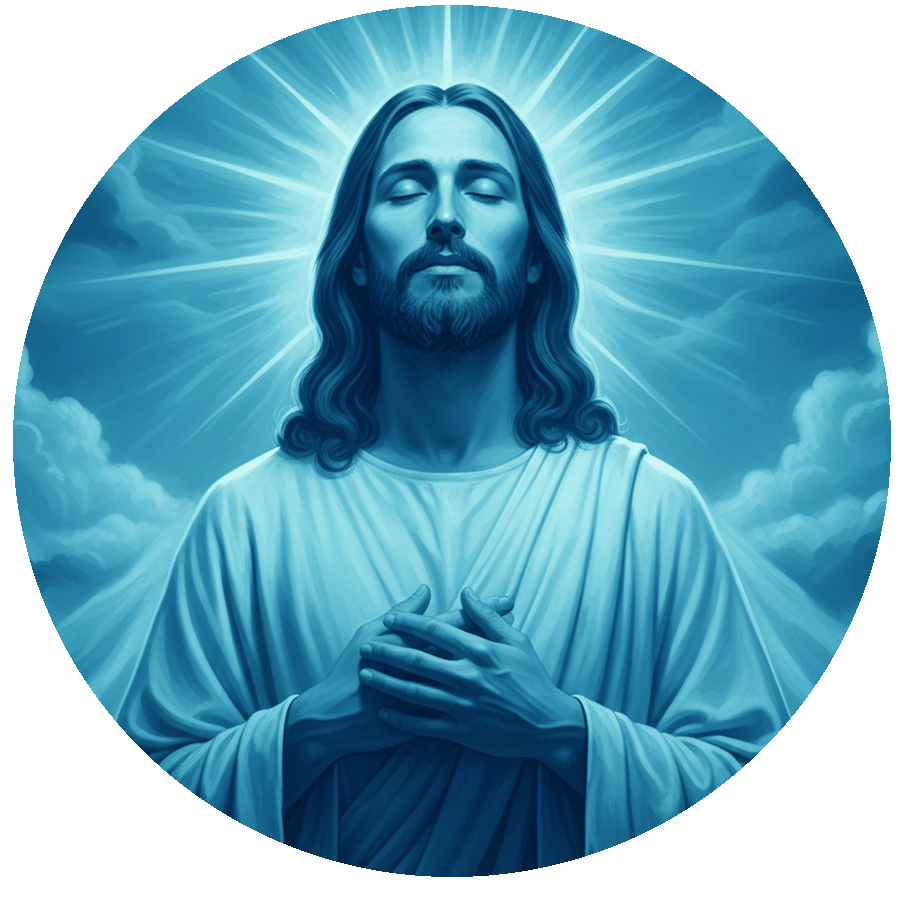
Jesus Christ, the eternal guide and Redeemer, entered this same field
of tension. He walked amidst temptation, conflict, and suffering,
and He revealed the sacred art of discernment: the ability to separate
good from evil, truth from falsehood, and the eternal from the passing.
In His words and in His deeds, He called all to follow Him, not as
passive witnesses, but as active participants in the work of creation—creators
of the good, even in the face of the powers of evil.
Good and evil, like twin currents, flow eternally through creation.
Neither destroys the other, and neither is ever wholly absent. At
times the light rises in triumph, illuminating generations with wisdom
and justice. At other times the shadow spreads, clouding the world
with cruelty, greed, and violence. This rhythm belongs to the nature
of existence, yet it is not destiny. For into this eternal cycle steps
the human soul, endowed with the spark of the Creator, capable of
shaping destiny through the free act of choosing the good.
Without the labor of the human spirit, the good cannot stand victorious.
It must be born anew in every heart, chosen again and again in defiance
of the forces that pull toward corruption and decay. Here lies the
mystery: good and evil may both exist eternally, but only the human
being, as co-creator with the divine, has the power to transform the
struggle. By choosing the good, the soul draws upon the highest potential
of the primal Source, receiving strength and wisdom to manifest light
where darkness would otherwise reign.
Evil, as a force of nature, surges in endless waves. It cannot be
eliminated, for it is woven into the fabric of the created order.
Yet Christ revealed a deeper secret: evil can be overcome, transmuted,
and turned into a servant of the good. The true disciple learns not
only to resist evil, but to transform it—to face the storms of
temptation and suffering, and by the power of love and spirit, to
convert shadow into light. This is the victory of the “creator-man,”
the spiritual human who rises above mere instinct and animal desire,
and who becomes a vessel of divine transformation.
But there is a danger, and it is the danger that has claimed countless
souls through the ages. Those who fail to learn the art of discernment,
who do not distinguish between the forces of good and the forces of
destruction, fall into the state of the “beast-man.” They
mistake power for goodness, appetite for truth, and violence for strength.
In doing so, they surrender their divine calling, and instead of creating
the good, they perpetuate the reign of darkness.
The Order of the Sanctuary exists as a reminder of this eternal struggle
and as a fellowship of those who choose the higher path. It is not
a denial of the existence of evil, but a commitment to the transformation
of evil through the conscious act of creation. Every brother and sister
who enters this circle joins in the work of shaping a world where
the light is chosen, where justice is pursued, and where love is made
real.
Thus the teaching of dualism is not despair but hope. It is not the
proclamation that good and evil are locked in endless stalemate, but
the revelation that human beings, through the example and power of
Christ, hold the ability to tip the balance. Christ Himself showed
that even in the deepest darkness, the light cannot be extinguished,
and through His path we are invited to become creators of the good
in our time.
The struggle of light and shadow continues in every age. It is present
in every society, every heart, and every choice. Yet the promise remains:
those who discern, those who create, and those who follow the way
of Christ will become not victims of this duality, but masters of
it. They will know the art of transformation, and through them the
eternal good will shine.
This is the sacred labor of the Order of the Sanctuary. It is the
call to recognize the duality, to enter into the struggle with wisdom,
and to stand as co-creators with the divine, bringing forth the good
that heals and renews the world.
The
Universal Law of Duality in the Teachings of Christ
In
the beginning of all human wisdom, before kingdoms rose and before
the written word was formed, there existed a sacred understanding
among the peoples of the earth — the mystery of Duality. From
the dawn of the world, mankind perceived that all things are born
of two natures: light and darkness, creation and destruction, love
and fear, life and death. These are not enemies alone, but eternal
companions, each revealing the nature of the other. Without darkness,
the light would be unseen; without silence, the song would lose its
beauty; without trial, virtue would never be proven.
This ancient truth — the law of the Two — is the first of
all divine teachings. It is the root from which all wisdom grows,
the key passed from generation to generation. Every tribe, every nation,
and every soul that has walked the earth has carried within itself
the struggle between the higher and the lower, between the angel and
the beast, between the divine spark and the shadow that seeks to extinguish
it. This struggle is not a curse, but a sacred opportunity: for only
through discernment can the human spirit become radiant with truth.
And so came the Christ, the Living Word of God, to reveal once more
what had been forgotten: that the power to choose between Good and
Evil lies within every soul. He did not deny the existence of darkness,
for even the night is created by God. But He taught that the true
path is the Middle Way — the sacred line between extremes, where
the spirit remains steadfast, and love governs every deed.
For Jesus Christ, the Holy Avatar of Light, showed us that Goodness
is not the absence of Evil, but the mastery over it. He did not destroy
the shadow — He transfigured it. Where hatred burned, He sowed
compassion; where greed consumed, He offered charity; where death
reigned, He brought eternal life. In His every word resounded the
message: “The battle between Light and Shadow is the forge in
which the soul is purified.”
From the smallest village to the greatest empire, from the elder of
a tribe to the scholar of the temple, the same law holds true. What
is considered “good” or “evil” may wear different
names in different lands, but the divine principle remains unchanged
— the heart of man must learn to discern. In every culture, righteousness
is that which nourishes life, uplifts the weak, brings harmony, and
serves love. Wickedness is that which destroys, divides, and enslaves.
These truths transcend race and time; they are universal, as constant
as the rising of the sun.
Therefore, every seeker who follows the path of Christ must understand
the sacred function of Duality: it is not to condemn mankind, but
to awaken him. For in knowing what is dark, one learns to love the
light. In feeling pain, one learns compassion. In facing temptation,
one learns strength. Thus the dual law is not punishment, but preparation
— the training ground for the eternal soul.
Christ Himself walked this narrow path. He faced temptation in the
wilderness, He endured betrayal, and He met death with forgiveness.
In this He revealed that the perfect human being is not one untouched
by evil, but one who has seen it and chosen the good despite it. This
is the divine secret of the Balance — to live among the opposites
and yet remain centered in love.
So I tell you, children of light: do not seek a world without darkness,
but rather a heart so strong that the darkness cannot rule within
it. For as long as the world exists, the two forces will dance —
the one rising, the other falling, forever seeking equilibrium. Yet
through the guidance of the Christ, humanity is given the power to
tip the scale toward goodness again and again.
Let the Order of the Sanctuary, and all who walk in its spirit, remember
this truth: the dual law is eternal, but it is love that gives it
meaning. It is not enough to name good and evil — one must live
the good and redeem the evil. When we forgive, we turn darkness to
light. When we share, we turn greed to generosity. When we love, we
turn fear to peace.
And thus, through the heart awakened in Christ, the eternal cycle
becomes the ladder to heaven. The divine paradox — that both
light and shadow serve the same Creator — is the mystery of all
mysteries, the wisdom of the Cross itself: that suffering becomes
salvation, and death becomes resurrection.
Therefore, follow the teaching of the Eternal Duality, not as a curse
but as a covenant. For the path of discernment is the path of true
freedom. It leads beyond all divisions of nation, creed, and bloodline,
and unites all souls beneath one law — the Law of Love, which
is the breath of God Himself.
Let every man and woman who seeks the truth hold to the middle path
of the Christ: neither blinded by judgment, nor seduced by indulgence,
but standing firm in wisdom, mercy, and compassion. In this sacred
balance lies the peace of the world, the freedom of the soul, and
the eternal harmony of creation.
And so I say unto you: Walk in the light, but know the shadow. Love
without measure, discern without fear. For the good that lives in
you is the reflection of the Eternal Good — the very face of
God shining through the human heart.
On
the Sacred Balance of Good and Evil in the Eyes of Christ
The
world is woven not only of light and darkness, but of countless shades
that lie between. Though it is easy for the mind to name what is Good
and to condemn what is Evil, the heart of creation is not so simple.
For within every man and every deed there flows a mixture of both
— the spark of divine light and the shadow of mortal weakness.
And thus, the true disciple must learn to see not only with the eyes
of judgment, but with the eyes of mercy and understanding.
When our Lord Jesus Christ walked upon the earth, He beheld this mystery
clearly. He saw that not all darkness is void, nor all light pure.
The wheat and the tares grow together in the same field; the purest
heart may falter in temptation, and the most sinful may yet harbor
a secret longing for redemption. Therefore, He taught not a rigid
law of condemnation, but a living law of discernment — one that
weighs every act in the scales of compassion, and measures every soul
by the intent that moves it.
For the line between Good and Evil does not lie in the world around
us — it runs through the heart of every human being. At times
it is bright and clear; at other times it is blurred and shifting
like mist over a valley. What seems righteous in one moment may carry
the seed of pride, and what appears wicked may conceal a lesson or
a hidden grace. The wise do not rush to judgment, for wisdom listens
before it speaks and sees before it decides.
The gray realm — that uncertain borderland where light and shadow
mingle — is the testing ground of the soul. Here the easy answers
vanish, and the spirit must walk carefully, guided not by rigid dogma,
but by the quiet whisper of divine conscience. This is where true
morality is born — not in blind obedience, but in the courage
to choose with awareness, to balance mercy and justice, and to act
from love rather than fear.
Many who seek righteousness fall into the trap of extremity. They
divide the world too sharply — saints on one side, sinners on
the other — and forget that even saints have wept in guilt, and
sinners have wept in repentance. Yet Christ showed us another way.
He sat among the poor, the broken, and the outcast; He forgave the
thief and blessed the penitent. His holiness was not distant, but
compassionate. He knew that Goodness is a flame, and even in the dimmest
ember there remains the power to reignite the fire.
To walk in the light does not mean to never fall into shadow. It means
to rise again when one has fallen, to transform error into wisdom,
and to cleanse guilt through acts of kindness. Every sin can be redeemed
by love, and every wound healed by forgiveness. For even the one who
has stumbled into darkness may become a bringer of light, having learned
through suffering what others have not yet seen.
The Order of the Sanctuary teaches this sacred moderation — that
the war between Good and Evil is not won through zealotry or violence
of spirit, but through consciousness and compassion. Each choice,
each word, each deed must be weighed with care. Perfection is not
given to mortals, but understanding is. The true warrior of the Light
knows that sometimes the path toward goodness is not the easiest or
the cleanest, yet it is the only path that heals.
Thus, when you face a choice where both roads are flawed, do not despair.
Seek the way that brings less harm, that opens the heart rather than
closes it. Choose that which restores, even if it cannot yet perfect.
For in this world of imperfection, the divine measure of Good lies
not in the absence of Evil, but in the sincere striving to overcome
it.
Remember also: to resist temptation does not mean to never feel it.
To be tempted is part of being human; to rise above it is what makes
one divine. When you stumble, let repentance not be despair, but renewal.
Each act of atonement sends ripples of light into the world, healing
not only yourself but the fabric of creation.
And so, my beloved, live not as judges of others, but as guardians
of your own heart. Recognize the shadows within you, not to condemn
them, but to redeem them. For the greatest victory of Good is not
to destroy Evil, but to transform it into a servant of the Light.
This is the mystery of the Christ — that He turns all things
toward redemption, that no darkness is too deep for His radiance,
and no soul too lost for His grace. Walk, then, in awareness. Weigh
your deeds. Forgive others as you forgive yourself. Strive always
toward the light, but remember that even the twilight carries the
promise of dawn.
For the children of God are not perfect beings, but conscious ones
— who, in every struggle between light and shadow, seek to love
more, to understand more, and to bring a little more Good into the
world. This, and this alone, is the true victory over Evil.
The
Path of the Creator of Light
The
true Creator of Light stands not only against the darkness that surrounds
the world, but also against the shadow that seeks to dwell within
his own heart. For though the temptation may arise to use the weapons
of darkness to achieve the ends of light, this is the most subtle
and perilous of all deceptions. Evil, once invoked, never serves without
a price. Its methods carry within them the seed of their own corruption,
and even when borrowed for noble intent, they breed new forms of darkness
that soon obscure the very light they were meant to reveal.
It is a great and sorrowful truth that one cannot create the Good
through the instruments of Evil. The sword of injustice, though wielded
for a righteous cause, still cuts with the same wound. The word of
deceit, though spoken for peace, still poisons the heart that utters
it. And the heart that consents to compromise with corruption, even
in the name of goodness, has already allowed the shadow to take root
within its soul.
The laws of the Spirit are eternal and unbending: whatever one sows,
that shall one also reap. If you sow with the hand of darkness, you
will harvest its fruit, no matter what good you had intended. The
world itself reflects this truth in every act and every consequence.
The way of the Christ, the eternal Light of the world, is the way
of purity — not in appearance, but in intent, in will, and in
method. To walk with Him is to know that the end never sanctifies
the means, but rather, the means sanctify the end.
Many who wish to do good become entangled in this snare. They see
injustice and wish to destroy it swiftly. They see suffering and wish
to end it by any means. Yet the true disciple knows that darkness
cannot be cast out by darkness; only light can do that. Hatred cannot
conquer hatred; only love can transform it. And deceit cannot protect
truth; only truth itself can endure. Every compromise with Evil, however
slight, adds another chain to the bondage of the world.
The Warrior of Light must therefore learn the most difficult art —
the art of refusal. To renounce the easy path of expedience, to reject
the seduction of quick victories, and to trust instead in the slow,
silent, invincible power of the Good. The light does not rush; it
does not rage; it simply shines. And in its steady shining, all darkness
dissolves.
This inner firmness — this unwavering loyalty to the Good —
is the mark of the true servant of the Christ. He walks through a
world of confusion and deceit, yet his steps are clear and his purpose
unclouded. He does not borrow from evil to hasten good; he creates
good with the same purity from which it was born. His actions flow
from love, his words from truth, his heart from justice.
Understand this deeply: when you use the ways of Evil to reach for
the Good, you strengthen the dominion of Evil in the world. Its methods
multiply themselves; its nature spreads like a contagion. A lie told
for justice will give birth to more lies; a violent act committed
for peace will plant the seeds of new wars. The shadow grows wherever
it is invited, and its appetite is endless. Only in abstaining from
its methods entirely can the soul remain free.
Christ Himself walked this path of refusal. He did not summon angels
to destroy His enemies. He did not silence the wicked with force,
nor rule by the power of fear. Instead, He overcame the Evil of the
world through the unyielding strength of love, forgiveness, and truth.
He conquered the world not by fighting it, but by transcending it.
This is the mystery of divine victory — that it comes not through
domination, but through transformation.
So let the Warrior of Light be vigilant. Let him stand firm in the
knowledge that every small choice carries eternal consequence. Let
him purify his intentions, and act always from the center of love.
When temptation whispers, “Take the shorter path, for the end
is good,” he must answer, “The end and the way are one.”
True power lies not in the destruction of Evil, but in its transmutation
— in the quiet courage to do what is right even when the world
demands compromise. To stand for the Light in a time of shadow is
to bear the cross of Christ within oneself. It is not an easy road,
but it is the only road that leads to redemption.
Therefore, my beloved, do not bargain with the darkness. Do not justify
falsehood for the sake of peace, nor cruelty for the sake of order.
The light that mingles with shadow loses its strength; but the light
that remains pure, even in suffering, becomes eternal. Every act of
untainted Good sends ripples through the cosmos, healing what Evil
has torn, mending what fear has broken, and restoring what ignorance
has darkened.
This is the sacred calling of the Creator of Light:
To reject the instruments of darkness,
To stand in purity of heart,
To act only for love’s sake,
And to bring the kingdom of Heaven nearer to Earth —
Not through force, but through faith.
Thus is the world redeemed, one pure act at a time.
The
Knowledge of the Evil in the World
You
have walked through deep valleys, climbed the heights of the world,
yet you have always striven for the Highest. From where does the knowledge
of the good in the world come, if not from within yourselves? You
have omitted nothing, been spared nothing. You have seen, experienced,
and felt every stage, every level, and every aberration of human suffering.
Is not the good implanted within you, for otherwise you would feel
neither compassion nor mercy? Human beings do not live by bread alone.
They are social creatures, and it is through their social nature that
they come to recognize the good. As children, they learn the distinction
between what ought to be done and what ought to be left undone. Later
in life, they come to understand the consequences of their actions
directly through their fellow human beings. Yet it is only in middle
age, when the body begins to decline, that one truly comes to know
compassion as a profound inner experience. Only when one's own self
is at stake-one's most precious material and physical endowments-does
one become genuinely sympathetic and empathetic toward every form
of suffering. A young person may indeed feel pity, yet this pity is
always, in one way or another, centered upon the self. A person in
middle age likewise perceives suffering most acutely when confronted
with the consequences of evil, chaos, and illness within his or her
own life. Only the older person has matured sufficiently to experience
compassion not merely as a metaphysical concept, but to devote the
entirety of intellect, spirit, and a fully ripened soul to rising
above pain, illness, suffering, chaos, and guilt. With every fiber
of the body, such a person longs for a world made whole: for healthy
and strong people, and for compassion toward all who suffer, so that
human beings may support and uplift one another wherever no one can
continue alone. It is the world itself, it is the condition of being
human, and it is the cycle of life through which humanity learns to
distinguish good from evil. The more mature one becomes, the more
clearly the outlines of what is to be called good or evil emerge.
At that stage, one no longer quarrels over details but seeks solutions
instead. A mature person is also aware that, here as everywhere, action
is more important than theory or one's personal convictions on the
level of the mind. Whoever acts becomes a redeemer of the world, just
as the avatar one has chosen to pursue the highest of all possible
aims for the world. To act is nobler than to speak. Speech alone is
insufficient and estranges us from true purpose, while inaction is-and
remains-nothing at all, however beautifully one may adorn it with
words. The knowledge that the world cannot be healed by words alone
is laid bare at the very heart of the Sanctuary of the Order. No one
need fear it, and no one need search for it. Whoever acts creates
a world, and through action in the world comes to know what is good
and what is evil.
Curiously enough, people argue endlessly about what the good is and
what ought to be done in order to bring it into existence. Yet it
is precisely through this disputation that they create evil, for they
reveal themselves unwilling to do what is good. To help, to support,
to give-and also to receive-to create something together with other
people: all these are active ways of transforming the world into a
better one. None of these actions is ignoble or beneath human dignity.
On the contrary, they ennoble the human being whenever one joins with
others to create something without expecting anything in return. To
bring this creative power-the power of creation that resides within
the human spirit and soul-fully into being, and in doing so to create,
beyond doubt, what is right and good, is the remarkable gift of those
who follow their Avatar, Jesus Christ, or, depending upon their cultural
heritage, another avatar. Their capacity to elevate themselves through
their deeds, becoming as angels or as heroes, is of decisive importance.
For it is action that ennobles, honors, and ultimately brings fulfillment,
whatever form that action may take. It is toward this that every human
being should orient himself or herself. There are Christian communities
that live as mendicant monks, whose calling is to express love, sustain
life, uphold truth, and offer assistance to their neighbors through
their deeds. Every Christian order bears witness to the conviction
that the goal of the world is the complete lifting of every burden,
every form of suffering, and every misfortune, and that the members
of the order seek, through the work of their own hands, to lead this
world toward Paradise as fellow creators. In this they do well, and
they offer all of us an example of faith put into living practice.
For they follow their Avatar directly and reorder their entire lives
in service to that calling. Yet not everyone possesses the strength,
the perseverance, or the conviction required for such a path. Every
person must understand that he or she may never become a good monk
or a good nun, or may never choose the monastic life because of its
many sacrifices. But this is not required. For Jesus Christ, our Lord,
grants every human being the opportunity to ennoble his or her own
life completely through deeds, wherever that person lives and works-wherever
one encounters other people, animals, plants, material things, or
even simply ideas and their realization. It does not take much to
begin acting. Everyone is capable of doing so, everywhere and at any
time. Whoever is unwilling has already surrendered. Whoever is not
yet able will bring nothing into being. But whoever is prepared to
let deeds speak always takes another step forward upon the path of
life. It is no coincidence that the Scouts do not say, "One good word
every day," but rather, "One good deed every day." For everything
is measured by deeds-by their fruits: whether they possessed true
worth, whether they brought forth something of value, or whether they
faded into oblivion and left no lasting memory. Thus every person,
wherever he or she may stand in life and wherever there is an opportunity
to create something together with others, can choose to do good and
refrain from doing evil.
Good and evil do not always present themselves in the simple and unmistakable
contrast of black and white. More often they appear in countless shades
of gray; or, depending upon whom one asks, what one person perceives
as evil may be regarded by another as good, while what is seen as
good by one may appear as evil to another. At other times, they are
a complex mixture of many different levels and elements, each containing
something of both. The diversity of cultures and the dialogue between
them bear witness to the fact that even the most fundamental questions
remain subjects of dispute, and that people often fail to find common
ground when judging a particular matter. If good and evil could be
determined with absolute certainty, there would surely be no disagreements
among different ethnic groups, tribes, clans, families, countries,
nations, or states. Everything would exist in harmony; evil would
long since have been eradicated at its very root and would never again
appear. Humanity would already be living in Paradise. Instead, conflict
exists everywhere among human beings. This alone demonstrates that
the dualism of good and evil is not understood in a universally identical
way. Customs and traditions often play an equally important role in
determining whether something is regarded as good or evil. Even among
indigenous peoples there are established rules and hierarchies that
define precisely who may do what, and who possesses-or is permitted
to possess-certain rights and privileges. Whenever someone steps beyond
these accepted boundaries, the act is considered evil, because hierarchies
are circumvented, relationships of obligation are dissolved, rules
are disregarded, and other people are thereby dishonored. The consequence
is that evil is repaid with evil, giving rise to a spiral of violence.
Such consequences may ultimately culminate in war. For this reason,
it is wiser for a peaceable person to respect the customs and rules
of others, however absurd they may seem, however distant they may
appear from one's own understanding of reality, and even when they
themselves strike us as forms of evil while being regarded as entirely
normal by those who live according to them. The fact that people do
not perceive good and evil in the same way is one of the essential
contradictions that confront every mature person. It is therefore
of great importance to understand the motives of others rather than
remaining confined within one's own conception of evil. A tribe living
in the rainforest cannot be judged through the eyes of modern urban
society, just as the modern city cannot be understood through the
perspective of the rainforest tribe. A city dweller may regard the
rivalries and wars between tribes as primitive and evil, yet within
the life of the tribe they may serve an important social function,
because every individual is engaged in confronting his or her own
inner darkness. When violence is projected outward and evil is perceived
as coming from outside the community, the members of the group become
capable of preserving solidarity and nurturing what they regard as
the good within their own people. Likewise, a member of such a tribe
might find it incomprehensible that a society calling itself modern
could tolerate countless homeless people who have, in practical terms,
been abandoned by the very society to which they belong. Such a person
would almost certainly regard this condition as evil and would judge
the society itself, together with its people, to be evil because no
one makes the effort to care for members of their own community. Very
often it is far from clear who is truly good or evil, or why one person
judges something genuinely good to be evil while considering something
truly evil to be good. This reveals that even modern society, despite
all its confidence in itself, has no right to congratulate itself
as the ultimate judge of who is right or wrong, who is good or evil,
or even to assume that it possesses the authority to decide such questions.
For precisely this reason, evil must be recognized through human suffering,
and suffering should be regarded as the surest sign of its presence.
Whoever suffers beyond all measure has been touched by evil; whoever
flourishes lives in harmony with the surrounding world, with society,
and with other people. Therefore, the capacity to feel the suffering
of others-what we call compassion-is the most important quality a
human being can possess. A person who cannot feel compassion for those
afflicted by suffering cannot truly be good, for such a person lacks
the very capacity for goodness. Without empathy and fellow feeling,
reason remains confined to the intellect alone and never finds its
way to the heart. And this, too, is why so many people become cruel:
they are unable to find within themselves the capacity for compassion.
You should not punish those who are incapable of compassion, for many
have been born with this deficiency and are scarcely able-if at all-to
change their innermost nature. This means that they lack the spiritual
and emotional capacity to place themselves in the position of another
human being, and that they may never have experienced compassion for
any living being, whether for plants, animals, other creatures, or
even for fellow human beings. This inability to project oneself into
the circumstances of others is, in some people with strongly narcissistic
or autistic dispositions, particularly pronounced. In the present
age of plutocracy, these very characteristics often elevate such individuals
to positions of great leadership. They possess few inhibitions when
it comes to issuing orders or assuming responsibility for money, wealth,
property, power, and the employment of others, yet they frequently
possess the least developed capacities for empathetic leadership of
all. This deficiency means not only that they are often unable to
fulfill the true responsibilities of leadership-that they become neither
great leaders nor truly great human beings-but also that they are
nevertheless admired and even idolized by those who follow them. This
is because human beings possess a deeply rooted instinct to follow
a leader within a group, an instinct that appears to be strongly embedded
in our biological nature. Yet this also demonstrates that people often
choose the wrong leaders, and that it is unwise to elevate those who
merely possess the desire or aptitude to command into objects of leadership
and devotion. Such individuals will not faithfully fulfill their responsibility
toward the community or safeguard the well-being of their own people.
Rather, because of their deficiencies in empathy, compassion, and
love for others, they will ultimately lead those entrusted to them
toward ruin. For this reason, one should never follow such people,
but always one's own inner Avatar. For us, as the Order of the Sanctuary,
that inner Avatar is our Lord and Master: Jesus Christ, the embodiment
of all that is good, of the highest forms of compassion, and of the
fullest realization of everything that is truly human-our holy guide,
whom we allow to come into being within ourselves. We do not merely
replace one worldly leader with an exemplary metaphysical one and
allow ourselves to be led astray once again. Rather, we follow Jesus
Christ as the symbol of the highest form of love that human beings
are capable of experiencing. He need not appear to us as a revealed
person within our spirit and soul, but as the living symbol, the ideal,
the Avatar of the purest and highest love itself. By orienting ourselves
toward Him as the symbol of perfect love, we are able to complete
the world through our deeds and to distinguish the good from the evil-a
task that, understandably, presents perhaps the greatest challenge
of all for most human beings.
Die
Kenntnis von dem Bösen in der Welt
Ihr
seid durch tiefe Täler gestiegen, habt die Höhen der Welt erklommen,
doch immer habt ihr nach dem Höchsten gestrebt. Woher kommt das Wissen
um das Gute in der Welt, wenn nicht von euch selber? Ihr habt nichts
ausgelassen, wurdet durch nichts verschont, habt alle Stufen, Ebenen
und Abartigkeiten von menschlichem Leiden gesehen, erlebt, gespürt.
Ist das Gute nicht in euch selber hineingelegt, und würdet ihr sonst
kein Mitleid und kein Erbarmen spüren? Der Mensch lebt nicht von Brot
alleine, er ist ein geselliges Wesen, und seine Geselligkeit zeigt
ihm das Gute auf. Er lernt als Kind die Unterschiede dessen, was man
tun, und was man unterlassen sollte. Er lernt zu späterem Alter direkt
die Folgen an seinen Mitmenschen. Er ist mittlerem Alter aber, wenn
sein Körper anfängt zu zerfallen, fühlt er Mitleid als tiefe Empfindung
kennen. Erst wenn es um sein eigenes Ich geht, um seine wertvollsten,
materiellen, körperlichen Anlagen, wird er wahrhaft mitfühlend und
emphatisch gegenüber allen Formen von Leid. Ein junger Mensch kann
zwar Mitleid empfinden, aber dieses Mitglied bezieht sich immer nur
auf ihn selber. Ein Mensch in mittlerem Alter kann ebenfalls Leid
nur dann empfinden, wenn er die Konsequenzen des Bösen, des Chaos
und der Krankheit direkt an sich selber wahrnimmt. Erst der ältere
Mensch ist reif genug, Mitleid nicht nur metaphysisch zu empfinden,
sondern seinen ganzen Intellekt, seinen gesamten Geist und seine vollendete
Seele darauf zu konzentrieren, von Schmerz, Krankheit, Leid, Chaos
und Schuld daran zu abstrahieren. Mit jeder Faser seines Körpers wünscht
er sich eine heile Welt, gesunde, starke Menschen und Mitleid für
alle Leidenden, damit die Menschen sich gegenseitig unterstützen und
befördern, dort, wo es alleine nicht mehr weitergeht. Es ist die Welt,
es ist das Menschsein, und es ist der Zyklus des Lebens, über welchen
die Menschheit das Gute vom Bösen zu unterscheiden lernt, und je gereifter
im Leben man steht, desto klarer werden die Umrisse dessen, was als
gut oder als böse zu bezeichnen ist. Da wird aber nicht mehr um Details
gestritten, sondern es werden Lösungen gesucht. Dabei ist sich ein
gereifter Mensch bewusst darüber, dass auch hier die Tat wichtiger
ist als die Theorie oder die eigene Haltung auf der Geistebene. Wer
macht, wird zum Erlöser der Welt, genau wie der Avatar, welchen man
gewählt hat, um das Beste aller besten Ziele für die Welt zu erreichen.
Tun ist edler als sprechen, Sprechen ist ungenügend und sinnentfremdend,
und Nichtstun ist und bleibt nichts, auch wenn man es mit Worten gar
schön bereden kann. Das Wissen darum, dass die Welt durch Worte nicht
heil werden kann, ist ganz zentral im Sanktuarium des Ordens offengelegt.
Niemand braucht es zu scheuen, niemand muss es suchen. Wer tut, erschafft
eine Welt, und er erfährt, was gut und böse ist durch das Tun in der
Welt.
Eigenartigerweise streiten die Menschen darum, was das Gute ist, und
was man machen sollte, um es erschaffen zu können. Aber genau hierdurch
erschaffen sie das Böse, denn sie sind offenbar nicht bereit, das
Gute zu tun. Helfen, Unterstützen, Geben, auch Nehmen, etwas mit anderen
Menschen zusammen erschaffen, alle dies sind tatkräftige Möglichkeiten,
wie man die Welt in eine bessere Welt verwandelt. Nichts von alledem
ist unedel, wäre dem Menschen unwürdig. Ganz im Gegenteil adelt es
den Menschen, wenn er, ohne eine Gegenleistung erhalten zu wollen,
mit Menschen zusammen etwas erschafft. Dieses Erschaffen, dieses Schöpferkraftleistung,
welche in seinem Geist und seiner Seele steckt, ganz und gar umzusetzen,
und dabei zweifelsohne immer das Richtige, das Gute, zu erschaffen,
das ist das geniale Vermögen von Menschen, welche ihrem Avatar Jesus
Christus nachfolgen, oder, je nach Herkunft, einem anderen Avatar.
Ihr Vermögen, sich daran durch die Tat emporzuheben zu Engeln oder
zu Helden, ist dabei ganz entscheidend. Denn Tat adelt, ehrt und macht
erfolgreich, wie auch immer diese Tat aussah. Daran sollte sich der
Mensch ausrichten. Es gibt Christliche Gemeinschaften, welche als
Bettelmönche leben, deren Vermögen es ist, durch die Tat am Nächsten
Liebe, Leben, Wahrheit und Beistand zu leisten. Jeder christliche
Orden zeugt davon, dass das Ziel der Welt die vollständige Aufhebung
aller Lasten, aller Leiden und allen Unglückes ist, und dass die Teilnehmer
des Ordens durch ihrer eigenen Hände Arbeit diese Welt als Erschaffende
in das Paradies führe möchten. Daran tun sie gut, und geben uns allen
das Beispiel einer lebendigen Umsetzung. Den diese folgen direkt ihrem
Avatar nach, und stellen ihr eigenes Leben dafür vollständig auf den
Kopf. Nicht jeder aber hat die Kraft, die Ausdauer, die Überzeugung,
welche es dazu benötigt. Jeder Mensch aber muss verstehen, dass er
oder sie vielleicht kein guter Mönch und keine gute Nonne wird, oder
sich wegen der vielen Nachteile niemals für ein Klosterleben entscheiden
kann. Aber dies benötigt es auch nicht, denn Jesus Christus, unser
Herr, gibt allen Menschen die Möglichkeit, sich vollständig im eigenen
Leben durch seine Taten zu veredeln, und indem jeder an seinem eigenen
Orte, wo er lebt und arbeitet, wo er mit Menschen, Tieren, Pflanzen
und Gegenständen, oder einfach nur mit Ideen und deren Umsetzungen,
in Kontakt kommt. Es braucht nicht viel, um zur Tat zu schreiten.
Jeder kann es, überall zu jeder Zeit. Wer ist nicht will, hat schon
verloren. Wer es noch nicht kann, wird nichts erzeugen. Und wer bereit
ist, Taten sprechen zu lassen, der geht immer einen Schritt weiter
auf seinem Lebensweg. Nicht von ungefähr kommt es auch, dass es bei
den Pfadfindern nicht heisst "jeden Tag ein gutes Wort", sondern "jeden
Tag eine gute Tat", denn an der Tat, an den Früchten, wird alles gemessen,
ob es einen Wert hatte, ob es einen Nutzen erschuf, oder ob es in
Vergessen gerät, oder gar nicht in Erinnerung kam. So kann jeder für
sich das Gute tun, und das Böse sein lassen, wo immer er im Leben
steht und mit Menschen zusammen etwas hervorbringen kann.
Das Böse und das Gute kommen nicht immer als einfaches, eindeutiges
Schwarz und Weiss daher, sondern oftmals entweder in vielen Schattierungen
von Grau, oder aber, je nachdem, wen man fragt, wird das Böse von
dem einen in Schattierungen als das Gute gesehen, und das Gute in
Schattierungen als das Böse. Oder es ist eine Vermischung aus diversen
Ebenen und Elementen, welche von Vielem etwas enthalten. Verschiedene
Kulturen und deren Dialoge zeugen davon, dass selbst über Grundsätzliches
gestritten wird, und man keine Gemeinsamkeiten findet bei der Beurteilung
einer Sachlage. Wenn Gut und Böse so eindeutig sicher festlegbar wären,
gäbe es wohl keine Meinungsverschiedenheiten zwischen verschiedenen
Ethnien, Stämmen, Clans, Sippen, Ländern, Nationen und Staaten, sondern
es wäre alles in Harmonie, das Böse wäre längst an der Wurzel ausgerottet
und würde niemals mehr in Erscheinung treten. Alle Menschen würden
dann im Paradies leben. Überall aber herrscht Streit unter den Menschen,
und das zeugt davon, dass die Meinung über den Dualismus nicht als
universell gleich aufgefasst wird. Vielfach sind es Gebräuche und
Traditionen, welche ebenfalls mitmischen bei der Bestimmung oder Festlegung
darüber, ob etwas gut oder böse ist. Dies bedeutet, dass selbst bei
den Naturvölkern es Festlegungen und Hierarchien gibt, über welche
genau festgelegt wird, wer was machen darf, und wer über welche Rechte
und Privilegien verfügt oder verfügen darf. Wenn jemand über diesen
Rahmen hinausgeht, dann gilt das als böse, denn dann werden Hierarchien
umgangen, Abhängigkeiten aufgelöst, Regeln missachtet und die Menschen
werden hierdurch geringgeschätzt. Die Folge davon ist, dass Böses
mit Bösem vergolten wird, und dass eine Spirale der Gewalt entsteht.
Diese Folgen können bis zu einem Krieg ausarten. Deshalb ist es besser,
wenn man als friedfertiger Mensch Regeln anderer Menschen anerkennt,
auch wenn sie noch so absurd klingen, wenn sie noch so fern von jeglicher
Wirklichkeit abstehen, und selbst dann, wenn sie uns oftmals selber
als eine Form des Bösen gegenüberstehen, für andere Menschen aber
als ganz normal gesehen werden. Der Umstand, dass viele Menschen das
Gute, wie auch das Böse, nicht gleich betrachten, ist eine der wesenhaften
Widersprüche, auf welche gereifte Menschen treffen. Deshalb ist es
eben so wichtige, die Beweggründe von anderen Menschen zu verstehen,
und nicht bei der eigenen Sichtweise über das Böse stehenzubleiben.
Ein Urwaldstamm kann nicht mit den Augen der Moderne betrachtet werden,
aus der Sichtweise eines Grossstadtmenschen, aber natürlich auch umgekehrt
nicht. Ein Grossstadtmensch würde die Verfeindungen von Stämmen untereinander
und deren Kriege als primitiv und böse betrachten, aber sie haben
im Leben des Stammes eine wichtige Funktion, weil jeder Mensch mit
sich selber und seinen Abgründen beschäft ist. Wird die Gewalt nach
aussen gespiegelt, kommt das Böse von aussen, ist man bereit und fähig,
das Gute in der eigenen Gruppe hochzuhalten. Ein Urwaldmensch könnte
nicht begreifen, dass eine sich modern nennende Gesellschaft, eine
Grossstadt, über unendlich viele Obdachlose verfügt, welche faktisch
von der Gesellschaft verlassen wurden. Er würde diese Bewandtnis bestimmt
mit dem Bösen verbinden, und würde diese gesamte Gesellschaft und
die Menschen darin als böse deuten, weil niemand sich die Mühe macht,
diesen Menschen des eigenen Stammes zu helfen. Oftmals ist es nicht
so klar und eindeutig bestimmbar, wer gut oder böse ist, und wer aus
welchem Grund irgendetwas Gutes als böse erachtet, dagegen etwas wirklich
Böses als gut. Man erkennt daran, dass selbst die moderne, sich hochjubelnde
Gesellschaft genau so wenig sich im Recht darüber sonnen darf, wer
nun recht oder unrecht hat, wer böse oder gut ist, oder überhaupt
das Recht hat, darüber entscheiden zu können. Genau deshalb muss man
das Böse am Leiden der Menschen erkennen, und dies als sicherer Faktor
für das Böse betrachten. Wer leidet, über alles Mass hinaus, der ist
vom Bösen betroffen, und wem es gut geht, der steht in der Harmonie
mit seinem Umfeld, mit der Gesellschaft und mit den Menschen. Deshalb
ist die Empfindung von Leid, das so genannte Mitleid, die wichtigste
Eigenschaft des Menschen überhaupt. Ein Mensch, welcher kein Mitleid
spüren kann mit leidgeplagten Menschen, der kann nicht wirklich gut
sein, denn es fehlt im alles Vermögen, gut sein zu können, weil er
keine Empathie und kein Mitgefühl in sich hervorbringen kann, weil
seine Vernunft beim Verstand stehenbleibt, und weil er keinen Zugang
zu seinem Herzen finden kann. Und das ist auch der Grund, weshalb
viele Menschen bösartig sind, weil sie keinen Zugang finden zur Empfindung
des Mitleids.
Ihr sollt Menschen ohne Mitleid nicht bestrafen, denn viele sind mit
diesem Mangel geboren worden, und können ihr innerstes Wesen, wenn
überhaupt, kaum verändern. Dies bedeutet, dass ihnen jede geistige
und herzensbasierte Kapazität fehlt, sich in andere Menschen hineinzuversetzen,
und dass sie vielleicht noch nie Mitleid mit Wesenheiten gespürt haben,
seien es lebende Organismen gewesen, oder Pflanzen, oder aber andere
Lebewesen und sogar Menschen. Die Unfähigkeit, sich projektierend
in die Lage von anderen Menschen hineinzuversetzen, ist bei narzisstisch-autistisch
veranlagten Menschen teilweise stark ausgeprägt. Diese Eigenschaften
machen sie in der heutigen Zeit, in der Plutokratie, zu grossen Führungspersönlichkeiten,
welche keinerlei Hemmungen haben, Befehle zu erteilen, Verantwortung
für Geld, Vermögen, Eigentum, Macht und Anstellungsverhältnisse zu
übernehmen, und welche doch von allen Menschen über die absolut geringsten,
empathischen Führungsfähigkeiten verfügen. Dieses Defizit macht nicht
nur, dass sie meistens ihrer Verantwortung als Führungspersönlichkeiten
nicht nachkommen können, weder grosse Führer, noch grosse Menschen
sind, von den ihnen folgenden Menschen aber dennoch verehrt und angehimmelt
werden. Dies deshalb, weil es im Instinkt liegt, dass der Mensch immer
einem Führer folgt in einer Gruppe, und dass dieses sehr stark auf
der genetischen Ebene ausgeprägt ist. Aber es zeigt auch, dass die
Menschen meistens die falschen Führer wählen, und dass es nicht gut
ist, führungsstarke Menschen zu Führungsavataren zu machen. Denn sie
werden ihre Aufgabe für die Gemeinschaft und für das Überleben der
eigenen Leute nicht gut machen, sondern sie werden aufgrund ihrer
geringen Fähigkeiten und Eigenschaften bei der Empathie, beim Mitgefühl
und bei der Liebe zu den Menschen faktisch die Gruppe unter ihnen
in den Abgrund reissen. Deshalb sollte man niemals solchen Menschen
nachfolgen, sondern immer nur dem eigenen, inneren Avatar. Und das
ist für uns als Orden des Sanktuarium unser Herr und Meister, unser
Avatar der Versinnbildlichung alles Guten, der höchsten Formen des
Mitgefühles und der besten Umsetzung aller nur möglichen Menschlichkeit
Jesus Christus, unser heiliger Führer, welchen wir in uns selber in
Entstehung kommen lassen. Wir ersetzen nicht einen weltlichen Führer
durch einen vorbildlichen, metaphysischen, und lassen uns von diesem
ebenfalls in die Irr führen. Wir folgen Jesus Christus als dem Sinnbild
der höchsten Form der Liebe, welche Menschen überhaupt empfinden können,
und dabei muss er uns nicht als geoffenbarter Mensch im Geist und
der Seele erscheinen, sondern als Sinnbild der höchsten, reinsten
Liebe, als einem Idol oder Avatar dessen. An ihm als Sinnbild für
die höchste Form von Liebe können wir uns ausrichten, um die Welt
daran durch unsere Tat zu vollenden, und um das Gute vom Bösen zu
scheiden, was den meisten Menschen verständlicherweise von allem am
meisten Probleme bereitet.
The
Fall into the Depths of Matter
There
are scarcely any people who do not lose their sense of direction at
least once in the course of their lives. Life is burdensome; one is
not laid upon a bed of roses. Time destroys all matter, dissolves
it, and creates a new equilibrium. Such is the law of matter: nothing
is as it once was, nor does it remain so. Time is ever in motion,
and therefore matter is in motion; and thus all matter will forever
be transformed. If, therefore, you believe that you could conquer
matter and overcome the flow of time, let it be said to you that this
is not possible. It is therefore better that you acknowledge that
everything within you, everything you create, and everything you possess
as property will one day fall into destruction, dissolution, or rather,
into transformation. Even from you and from your body, something new
will arise when it enters into dissolution. What shall always endure,
however, so long as there are human beings, is the Scripture that
I have given unto you. But why is it not subject to time? Because
it is oriented toward something eternal, and because that eternal
thing is humanity itself, which shall endure as long as there are
human beings. I taught you to be good people, and I showed you what
you must do to become so, how you must develop yourselves. Many among
you did not believe my words. You thought they were something old,
something belonging to the past, something that existed within time
but possessed no eternity. Yet my message is different, for I taught
you to love one another-to love one another truly and sincerely-to
be good companions to one another, to be there for one another, and
not to despair when you find yourselves alone. But I also taught you
to recognize that matter is a double-edged sword, by which you are
bound to it, and which you must learn to master. Yet you must not
make the mistake of allowing yourselves to become bound by matter,
just as I, Jesus Christ, was born upon the earth to be an avatar unto
you, an example for life. The Cross has always been the symbol of
matter, and when I was bound to the Cross, it was the sign that my
cycle had been fulfilled and that I would once again depart from you.
Therefore, always remember that although matter may be useful to you,
and although you must master it, you must never allow yourselves to
be mastered by it. For it is relentless and merciless; its course
through time follows faithful laws which you cannot overturn. You
must indeed follow these laws and adapt yourselves to them, but you
must never allow your spirit and your soul to be ruled by matter.
For if you do so, you are lost and imprisoned within it. It will envelop
you and sweep you away with it. And this is precisely what happens
to those people who devote their entire lives to matter, who have
pledged themselves to it with body, mind, and soul, who follow its
laws, and who, in doing so, ultimately lose themselves completely
within those very laws.
You must master matter, yes, but you must not allow yourselves to
be mastered by it. This means that you must always remain lord and
master over your own spirit and your own soul. You may attain this
through a certain form of sensitivity, and by learning to feel compassion
for those who suffer. This is an ability that all of you can cultivate
in your daily lives, for you encounter many deeply afflicted people
each and every day. These people are sick in their bodies, in their
minds, and in their souls; they are disfigured inwardly and outwardly;
they are sick to the very marrow of their bones. Do not walk past
them as though they were not there. Care for them, watch over them,
and share with them the pain of the world. Thus you shall be perfected;
you yourselves shall become compassionate beings and shall learn to
overcome all materialism within yourselves. This is the elixir by
which materialism is overcome: it is called compassion. Yet it is
not a false compassion which says to itself, "It is well that this
has not happened to me, but only to another." Rather, it is a compassion
that fully receives and shares in pain, burden, and oppressive fear,
and in doing so seeks its own perfection. Therefore, this burden has
been laid upon all of you, so that you may become perfected human
beings: some by being burdened through fate with illnesses of body
and soul, both inwardly and outwardly; others by bearing their suffering
alongside them and helping to ease it. Only such a person, who has
turned away completely from matter and has become compassionate upon
the plane of the spirit and the plane of the soul, is a whole and
complete human being. Therefore, learn among yourselves the practice
of mutual help, just as though you yourselves were the sick. Learn
to support one another in your afflictions, of which every one of
you has more than enough, even when they are inward and hidden from
the eyes of others. Learn to open yourselves and to entrust yourselves
to one another, that you may experience how trust is received and
borne together. For this purpose, form this fellowship of brothers
and sisters, so that you may be perfected as human beings-people of
true goodness of heart, who devote their lives to the collective,
who enter into communion for the sake of the fellowship of all humanity.
Today's capitalist society has gone utterly astray. No justice any
longer protects you from personal ruin; no law protects your rightful
possessions, and the fruits of your labor have long since come to
belong to someone else. Such is the fate that you must learn to endure
in this life. This means that you must learn to walk through hell
while living in this world; that you must pass through this deep valley
of hell's winding paths; and that even the state-the community of
people in which you live and in which one day you shall die-does not
truly seek your good. The rich have become richer through this system,
while the poor have become more numerous. Roman property law has brought
all this upon you, and it will continue to do so unless you understand
what it is doing to you, and how, through it, you are cast ever deeper
into the realm of matter. In your greed, you have utterly failed to
recognize that capitalism cannot make you rich, but will instead make
you poor. You believed that everyone could become wealthy, and that
then all would be happy-perfectly happy-and would swim in material
abundance. Yet your materialism makes you rich and prosperous only
during a phase of economic growth and redistribution, while everyone
still benefits from that redistribution and there remains at least
a crumb of the cake for each person. But once the cake has been completely
divided, the pleasant game comes to an end, and you find yourselves
once again where you stood before the growth began. You hoped that
a materialistic system-which was not even just or balanced to begin
with-could make you wealthy forever and keep you so. Yet you failed
to understand that every surplus value arises only from human labor,
and that, sooner or later, the fruits of that labor will no longer
return to you, but will instead be taken by the one who holds the
rights of ownership. For he, the owner, is the true lord of the world,
because his property is protected by law. The patricians, the ruling
families of Rome, pondered for a long time how they might preserve
their property for all eternity against the masses of enslaved Romans
and ordinary citizens. They did not build a wall around themselves
to shield themselves from plunder. Instead, they created a system
of redistribution that continually appropriated the labor of the people.
And this ingenious stroke of plunderers and deceivers continues to
function even today, in your own age, for you still live under their
laws. Therefore know this: only I myself-your guide, your avatar,
and your exemplar-can lead you back onto the path of truth. All those
who declare that I am no longer of any authority should first explain
why the property laws established in those ancient days still remain
in force, and why you continue to live within this material reality.
Then you shall also see how desperate your situation truly is, and
that you have no choice but to orient yourselves toward this truth,
unless at last you learn to understand that these realities concerning
the material structures of the world and of society truly exist, and
that all that remains is for you to comprehend them. For this purpose
I have endowed you with the potential of the whole human being, and
the forces of nature themselves help you to understand these things
more clearly. For behold the world of living organisms: the animals,
the plants, and even the microorganisms. Everywhere you will discover
the same laws-that they are entirely bound within matter, yet possess
no money. They have no need of it. So likewise should you follow their
example, and establish communities of the Order that are founded neither
upon money, nor wealth, nor property, so that the primordial and pure
teaching of the Order, as a religion, may everywhere and at all times
inspire those who are good. Toward this you should direct yourselves,
and learn to understand what matter can do to your body, your mind,
and your soul. For in time it destroys your body; it also robs your
mind of its freedom; and it seeks to destroy your one true treasure-the
infinite and eternal soul, which can never die, because there will
always be living beings who possess a soul. Therefore, turn your mind
and your soul away from everything material, and learn to become beings
of the spirit through your own inner strength, through the power of
love, and through the capacity for truth, so that you may be truly
perfected as human beings. This is your purpose upon the earth: to
become pure, authentic, and truthful human beings, endowed with the
capacity for truth and sincerity, and with love as the very essence
of your being; to understand how love shall guide you throughout your
entire life, and how even knowledge, reason, and wisdom can exist
only within it, and can be perceived only through it.
Der
Sturz in die Niederungen der Materie
Es
gibt kaum Menschen, welche in ihrem Leben die Orientierung nicht mindestens
einmal verlieren. Das Leben ist beschwerlich, man ist nicht auf Rosen
gebettet, die Zeit vernichtet alle Materie, löst sie auf und erschafft
ein neues Gleichgewicht. Das ist die Gesetzmässigkeit von Materie,
dass nichts so ist und bleibt, wie es einmal war. Zeit ist immer im
Fluss, und deshalb ist die Materie im Fluss, und deshalb wird auch
immer alle Materie sich wandeln. Wenn ihr also denkt, das ihr die
Materie besiegen könnten und den Fluss der Zeit, so sei euch gesagt,
dass dies nicht möglich ist. Deshalb ist es besser, wenn ihr bekennt,
dass alles an euch, alles, was ihr erschafft und alles, was ihr besitzt
als Eigentum, irgendwann wieder in Vernichtung, in Auflösung oder
besser gesagt in Transformation fallen wird. Selbst aus euch und eurem
Körper wird etwas Neues entstehen, wenn er sich in Auflösung begibt.
Was aber immer Bestand haben wird, solange es Menschen gibt, ist die
Schrift, welche ich euch gegeben habe. Warum aber ist sie nicht der
Zeit unterworfen? Weil sie sich an etwas Ewigem orientiert, und weil
dieses Ewige die Menschlichkeit ist, welche, solange es Menschen gibt,
bestehen bleiben wird. Ich lehrte euch gute Menschen zu sein, und
zeigte euch auf, was ihr dafür tun müsst, wie ihr euch entwickeln
müsst. Viele von euch haben meine Worte nicht geglaubt, dachten, es
handle sich um etwas Altes, etwas Vergangenes, etwas, was zwar in
der Zeit existiert, aber über keine Ewigkeiten verfügte. Aber meine
Botschaft ist eine andere, denn ich lehrte euch, einander zu lieben,
wahrhaft, aufrichtig zu lieben, und einander gute Gefährten und Gefährtinnen
zu sein, füreinander dazu zu sein und nicht zu verzagen, wenn ihr
alleine seid. Aber ich lehrte euch auch zu erkennen, dass die Materie
ein zweischneidiges Schwert ist, wodurch ihr an sie gebunden seid,
und sie beherrschen lernen müsst. Aber ihr dürft nicht den Fehler
machen, und euch an die Materie binden zu lassen, so wie ich, Jesus
Christus, auf Erden geboren wurde, um euch ein Avatar zu sein, ein
Vorbild für das Leben. Das Kreuz war immer das Zeichen der Materie,
und als ich an das Kreuz gebunden wurde, war dies das Zeichen dafür,
dass sich mein Zyklus erfüllt hat, und ich euch wieder verlassen würde.
Deshalb denket immer daran, dass die Materie euch zwar nützlich sein
kann, und ihr sie beherrschen müsste, aber ihr dürft euch nicht von
ihr beherrschen lassen. Denn sie ist unerbittlich und grausam, ihr
Fluss in der Zeit folgt getreuen Gesetzen, welche ihr nicht durchkreuzen
könnt. Ihr müsst diesen Gesetzen zwar folgen, und müsst euch anpassen,
aber euren Geist und eure Seele dürft ihr nicht von ihr beherrschen
lassen. Tut ihr es doch, so seid ihr verloren und in dieser gefangen.
Sie wird euch umhüllen und mit sich fortreissen. Und genau das passiert
mit Menschen, welche ihr ganzes Leben an die Materie geben, sich ihr
mit Leib, Geist und Seele verschrieben, ihren Gesetzen nachfolgt,
und dabei sich selber vollendet in diesen Gesetzen verliert.
Ihr müsst die Materie beherrschen, ja, aber ihr dürft euch nicht von
ihr beherrschen lassen. Dies bedeutet, dass ihr immer Herr und Meister
über euren eigenen Geist und eure eigene Seele bleiben müsst. Ihr
könnt dies durch eine bestimmte Form von Feinfühligkeit erreichen,
und indem ihr Mitleid empfinden lernt mit leidenden Menschen. Dieses
Fähigkeiten könnte ihr alle im täglichen Leben erreichen und ihr habt
viele Beispiele von sehr gequälten Menschen, welchen ihr tagtäglich
begegnet. Diese Menschen sind krank in ihrem Körper, ihrem Geist und
ihrer Seele, sind innerlich und äusserlich entstellt, sind krank bis
in die Knochen. Lauft nicht an ihnen vorbei als wären sie nicht da,
kümmert euch um sie, tragt ihnen Sorge, und fühlt mit ihnen den Schmerz
der Welt, so werdet ihr vollendet werden, werdet selber zu mitfühlenden
Wesen und werdet allen Materialismus in euch überwinden lernen. Dies
ist das Elixier der Überwindung des Materialismus, es heisst Mitleid.
Aber es ist kein falsches Mitleid, welches sich denkt, dass es gut
sei, dass es einem nicht selbst betrifft, sondern den anderen. Es
ist ein Mitleid, welches in vollständiger Empfängnis von Schmerz,
Last und drückender Angst mitfühlt und sich versucht zu vollendet.
Deshalb ist euch alle dies als Last aufgebürgt, und damit ihr vollendete
Menschen werden könnte, die einen, indem sie durch das Schicksal mit
inneren und äusseren Krankheiten belastet werden, die anderen, indem
sie deren Leid mittragen, mithelfen, dieses zu lindern. Nur ein solcher
Mensch, welcher sich vollendet von der Materie abwendet und auf der
Geistebene und der Ebene der Seele zu einem mitfühlenden Menschen
wird, ist ein ganzheitlicher Mensch. Deshalb lernet unter euch die
gegenseitige Hilfe, genau so, als ob ihr Kranke währet, und lernet
euch gegenseitig zu unterstützen bei euren Gebrechen, von welchen
jeder von euch genug hat, auch wenn sie innerlich sind, und ihr sie
sonst immer vor den Menschen versteckt. Lernet euch zu öffnen und
euch anzuvertrauen, damit ihr erfahren könnt, wie das Vertrauen angenommen
und mitgetragen wird. Dafür bildet diese Verbindung von Brüdern und
Schwestern, und damit ihr als Menschen vollendet werdet, herzensgute
Menschen, welche ihr Leben für das Kollektiv hergeben, welche in eine
Verbindung treten für die Gemeinschaft aller Menschen.
Die heutige, kapitalistische Gesellschaft ist vollendet missraten.
Es schützt euch keine Gerechtigkeit mehr vor dem persönlichen Zerfall,
kein Gesetz schützt euer Eigentum, und eure Arbeitsleistung gehört
längst jemand anderem. Das ist das Los, welches ihr im Leben ertragen
lernen müsst. Dies bedeutet, dass ihr in der Welt durch die Hölle
gehen lernen müsst, dass ihr durch dieses tiefe Tal der Höllenwindungen
hindurchgehen müsst, und dass selbst der Staat, die Gemeinschaft der
Menschen, in welchem ihr lebt und eines Tages sterben werdet, euch
nichts Gutes antun will. Die Reichen sind reicher geworden durch das
System, und die Armen sind zahlreicher geworden. Das römische Eigentumsrecht
hat alle dies euch angetan, und wird es weiter tun, wenn ihr nicht
versteht, was es mit euch anrichtet, und wie ihr hierdurch noch tiefer
in die Materie stürzt. In eurer Gier habt ihr vollendet verkannt,
dass der Kapitalismus euch nicht reich machen kann, sondern arm machen
wird. Ihr dachtet, dass jeder reich werden könne, und dann alle glücklich
sein würden, vollendet glücklich, und im Materialismus schwimmen würdet.
Aber euer Materialismus macht euch nur reich und wohlhabend in einer
Wachstumsphase des Umverteilungssystemes, und wenn alle von dieser
Umverteilung profitieren, und für jeden noch ein Krume des Kuchens
übrigbleibt. Aber sobald der Kuchen vollendet umverteilt wurde, ist
das schöne Spiel aus, und ihr seid wieder dort, wo ihr vor dem Wachstum
wart. Ihr hattet die Hoffnung, dass ein materialistisches System,
welche dazu hin noch nicht einmal ausgewogen war, euch für immer hätte
reich machen und reich halten können. Aber ihr habt nicht verstanden,
dass jeder Mehrwert nur aus Arbeitsleistung heraus entsteht, und dass
irgendwann diese Arbeitsleistung nicht an euch zurückkommen wird,
sondern von demjenigen gestohlen wird, welcher über Eigentumsrechte
verfügt. Denn er, der Eigentümer, ist der wahre Herr der Welt, denn
sein Eigentum wird vom Gesetz geschützt. Die Patrizier, die vorherrschenden
Familien Roms hatten lange darüber nachgedacht, wie sie auf ewige
und unendliche Zeiten ihr Eigentum bewahren konnten vor den Massen
der sklavischen Römer und einfachen Bürger. Daraufhin bauten sie nicht
einen Schutzwall um sich herum, welcher sie vor Plünderungen bewahrte,
sondern sie erschufen ein System der Umverteilung, welches immer die
Arbeitsleistung der Menschen wegnahm. Und dieser geniale Streich von
Plünderern und Betrügern funktioniert noch heute, in eurer eigenen
Zeit, denn ihr habt noch immer deren Gesetze, nach welchen ihr lebt.
So wisset denn, dass nur ich selber, euer Führer, Avatar und Idol,
euch auf den Pfad der Wahrheit zurückbringen kann. Alle, welche von
mir aussagen, ich hätte keine Gültigkeit mehr, denn sagt, dass das
Eigentumsrecht von damals noch immer Gültigkeit hat, und dass ihr
in dieser materiellen Wirklichkeit lebt. Dann werdet ihr auch sehen,
wie verzweifelt eure Situation wirklich ist, und dass ihr keinerlei
Wahl habt, als euch daran auszurichten, wenn ihr nicht endlich verstehen
lernt, dass diese Wahrheit über die materiellen Strukturen in der
Welt und der Gesellschaft da sind, und dass ihr nur noch begreifen
lernen müsst. Dafür habe ich euch mit dem Potential des ganzheitlichen
Menschen ausgestattet, und die Naturkräfte helfen euch, dies besser
zu verstehen. Denn schauet in die Welt der Organismen, zu den Tieren,
den Pflanzen und sogar den Mikroorganismen, überall werdet ihr dieselben
Gesetzmässigkeiten entdecken, dass sie nämlich vollendet in der Materie
gefangen sind, aber dennoch über kein Geld verfügen. Sie benötigen
es nicht. Und genau so sollt ihr es ihnen gleich tun, und Ordensgruppen
bilden, welche nicht auf Geld, Vermögen oder Eigentum basieren, damit
die urreine Lehre des Ordens als Religion überall und allezeiten die
Guten befruchten kann. Daran solltet ihr euch ausrichten und verstehen
lernen, was die Materie euch an Körper, Geist und Seele antun kann.
Denn sie zerstört euch euren Körper in der Zeit, sie raubt auch den
Geist der Freiheit, und sie vernichtet euch euer einzig wahrhafter
Schatz, die unendliche, ewige Seele, welche niemals sterben kann,
weil es immer wieder Lebewesen geben wird, welche über eine Seele
verfügen. Deshalb sollt ihr euren Geist und eure Seele hinwegbewegen
von allem Materiellen, und sollt lernen, Geistmenschen mit Eigenkraft,
mit Liebeskraft und der Fähigkeit zur Wahrheit werden, auf dass ihr
als Menschen wahrhaft vollendet werdet. Das ist euer Ziel auf Erden,
reine, authentische und wahrhafte Menschen zu werden, mit der Fähigkeit
zur Wahrheit und Aufrichtigkeit, und dem Wesenskern der Liebe, und
wie sie euch führen wird über das gesamte Leben, und wie selbst Wissen,
Vernunft und Weisheit nur in ihr existieren können, nur durch sie
können betrachtet werden.
|